The first demonstration of popular feeling which has been made since the commencement of the trial of James A. Trefethen and William H. Smith for the murder of Deltena J. Davis of Everett, on Dec. 23, last, took place this morning as the prisoners were being brought into court. The trial is going on at the Superior Court, East Cambridge.
A few minutes before 9 o’clock a hoarse shout from a crowd outside the court house announced the approach of the prisoners, and a few seconds later they entered in charge of the officers and took their customary places in the dock.
The demonstration or the noise accompanying it was plainly audible in the court room, and caused no little comment amongst those assembled.
At 9o’clock Chief Justice Mason, Judges Hammond and Blodgett took their seats on the bench.
Dist.-Atty. Cooney and Att.-Gen. Pillsbury, for the government, and Hon. John D. Long and Hon. Marcellus Coggan, counsel for the prisoners, were all in their places. Previous to the commencement of the fifth day’s trial this morning a crowd surged around the entrance, and when at 8.45 the door was thrown open the court room was immediately filled.
Owing to the awful crush in the court room each day since the opening of the trial, it became necessary to make further arrangements for the accommodation of those who were interested in the trial.
Every lawyer in Boston or Middlesex county, who has half an hour to spare, finds himself in the East Cambridge court house this week, and the consequence was that the space usually reserved for the reporters was
Monopolized by the Lawyers.
It became a question as to who should go, and, with their usual luck, it fell to the lot of the reporters to vacate.
By order of Chief Justice Mason a platform was raised at the side of the court room, close to the jury seats, during the night, for the reporters, and the chief justice himself half an hour before the opening of the court, inspected the arrangements and ordered that they be made as satisfactory as possible.
Albert S. Southworth, expert in handwriting, was recalled, and said he had nothing to add to his testimony, as published in this morning’s paper.
Charles French, another expert, was called. He testified- “I am principal of French’s Business College in Boston, and an expert in handwriting for 30 years.
I have testified in the courts on several occasions.
I have examined the handwriting of Trefethen and Miss Davis very carefully, and also the anonymous letter.
“I have given from half to a full day on several occasions to examining them and have had taem(sic) in my possession for some weeks.
“From my examination of them I should say that the anonymous letter and the envelope were written by the same hand that wrote the Trefethen standard.
“I do not believe that Miss Davis could have written the letter.
“I first examined the papers with the object of forming an opinion as to whether they were written by Miss Davis or not, and I find points on the envelope and in the anonymous letter entirely inconsistent with Miss Davis’ handwriting.
“Another point which has had a good deal of influence with me is that the anonymous letter and envelope are evidently written in a disguised hand.”
“There are a number of changes or alterations in the anonymous letter and in the envelope, and I can think of no reason why she should make these changes, which were made after the words were written out, and these changes, to my mind, indicate a great deal of method for some special purpose.
“In my opinion there is an
Attempt to Disguise
in the letter and in the envelope the natural handwriting, and an attempt to imitate Miss Davis’ handwriting.
“My reason for thinking that is on account of some of the changes I see made here. A very marked one is in the beginning of the word ‘Mother,’ in the capital ‘M’.
“That letter ‘M’ was originally commenced up near the top with a little hook.
“The change in that letter is the down stroke that was put in afterwards. Miss Davis was in the habit of commencing her ‘Ms’ well down on the line, and then going up, and I have been unable to find a similar instance where she commenced with a hook.
“In my opinion that down stroke was
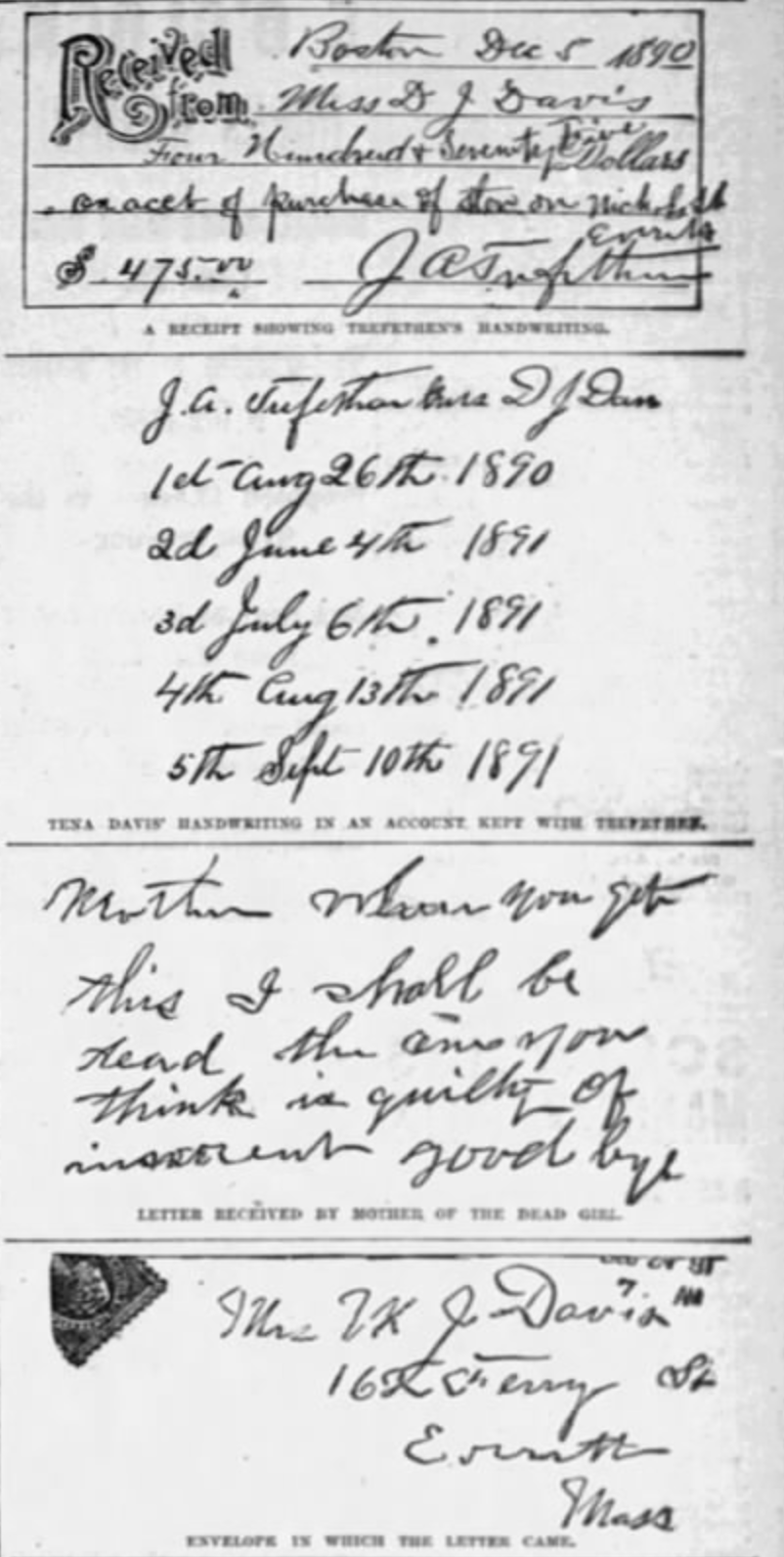
[picture – ‘A RECEIPT SHOWING TREFETHEN’S HANDWRITING.’]
[picture – ‘TENA DAVIS’ HANDWRITING IN AN ACCOUNT KEPT WITH TREFETHEN.’]
[picture – ‘LETTER RECEIVED BY MOTHER OF THE DEAD GIRL.’]
[picture – ‘ENVELOPE IN WHICH THE LETTER CAME.’]
placed there afterwards for the purpose of imitating her handwriting.
“I find the letter ‘h’ is not like Miss Davis’ in ‘when,’ and ‘y’ in ‘you.’ I find no down back stroke in Miss Davis’ handwriting. She was in the habit of making a loop in the ‘t’ as in ‘get,’ which is very peculiar.’”The up-stroke is made straighter than Miss Davis usually made the first part of her “t” in that position.
“I have endeavored to take as far as possible letters holding the same relative position in the standards and in the anonymous letter.
“The capital ‘I’ is different from Miss Davis’ capital ‘I.’ It is made with a stroke, commences, goes up round and curved down. Miss Davis first makes a down stroke and puts the up part on, two strokes and usually for a capital “I.” Miss Davis was not in the habit of dropping the first part off so far on. She never made a loop in the first part of it, and the last part is usually made straight, with occasionally a loop.
“The ‘I’ is made in two parts; this is in one. She usually carried the last part of the ‘I’ to a considerable height. This is made more in a straight line.
The “o” in “one;” I don’t find any like that in Miss Davis’ letter.
The “k” in sink is
One of These Altered Letters.
The second part of the letter “s” in this word “is” in the letter, has been, in my opinion put on, and is one of those changes.
“The ‘o’ in ‘of’ is not like Miss Davis’; the letter ‘t’ final in innocent is put like hers, and ‘oo’ is not like Miss Davis’, where it occurs in ‘goodbye.’ The first part of the ‘d’ in ‘goodbye’ is not like hers. The mark on the ‘y’ is not like hers, which is a loop.
“In the envelope there is the same feature in the first letter as in the “M” in another in the letter. The “J” is not like Miss Davis’. The capital “D” is very different.
“Miss Davis’ capital “D” was in one respect quite curious. She commenced hers quite low. This ‘D’ is not made in her way.
“The figure ‘6’ in ‘162’ on the envelope, I think, has been changed in the last part. The ‘S’ in ‘street’ is quite different from Miss Davis’ capital ‘S.” These are the points on which my opinion is based that the anonymous letter is not in her handwriting.
In the anonymous letter there is just what I should expect to find in an attempt to disguise a handwriting. Whatever party wrote it, it was undoubtedly written under great excitement, and I should not expect to find in that letter the same steady marks I should look for if it were written under other circumstances.
“Coming now to Mr. Trefethen’s handwriting, I find that he has a habit of commencing his capital ‘M,’ ‘N’ and ‘W,’ and a number of other capital letters, with the hook, which is very evident in the ‘M’ in ‘Mother,’ and the ‘M’ on the envelope.
“In making a small “h” he had a habit of curving the last part of the “h,” and of drawing the last part of the “y” down in the same way as I find them in this letter. He had the habit of writing a letter as I find it in this letter in the word “get,” drawing the downward stroke up at the bottom.
“In the capital letter ”M” the first part, instead of being well curved, a short straight line is there, as in the case in many of his letters.
“Miss Davis was in the habit of making her ‘I’s” above the line. This is below the line. My explanation of that is that it was done intentionally. If a party tried to imitate, I should expect to find some points of similarity, and his habit of carrying his ‘I’s below the line, which is an unusual thing. Her habit was to carry it above the line, a peculiarity which, I think, anybody knowing it, would have carried in his mind.”
“I think that is so clear a person would be likely to avoid it.
“The small ‘o,’ I think, is almost an exact facsimile of Trefethen’s handwriting. The word ‘good’ in
Trefethen’s Handwriting
is the same, and there is a marked similarity in the final ‘S.’ In the ‘M’ in “Mrs. Davis’ it is the same as the capital ‘M’ in the letter.
“The ‘J’ is made like Trefethen’s ‘I,’ carried below the line, and made with the same movement, and his capital ‘I’ is carried below the line, and is very like this ‘J’ in ‘M. J. Davis.’
“The capital ‘D’ is like his ‘D.’ The ‘f’ in ‘Trefethen,’ is very similar in Mr. Trefethen’s writing, and the ‘S,’ in “Street.’ There are some of these ‘s’s’ which I should say are fac similes of his. The word “Everett’ is very similar to his.”
Fac similes of the various letters and standards were here handed to the jury.
“The same is the case in the “M” in the agreement of Dec. 8 and the receipt of Dec. 5. There are 12 letters commencing with a similar hook. That is what I call a characteristic of Mr. Trefethen’s handwriting, and of such a nature that a novice in handwriting in trying to imitate handwriting would be very likely to overlook.
“The letter ‘J’ and the letter ‘I’ in the fourth line of the agreement are very much alike.
“The ‘d’s are the same in all Trefethen’s handwriting, and are the same as the ‘d’ in the first page, 10th line of the memorandum of agreement.
“In the word ‘Ferry,’ in forming the first part of the ‘F’ there is a similarity between Miss Davis’ and Mr. Trefethen’s way of making it.
“The letter ‘F’ in the word ‘First’ in the memorandum of agreement the ‘F’ in ‘Four’ in the receipt of Dec. 5, have the same peculiarity as the ‘F’ in ‘Ferry.’
“The ‘y’ in ‘Ferry’ and in the notice to the sheriff, in ‘county’ and ‘property’ show the same peculiarity.
“The ‘S’ in ‘street’ on the envelope commences with the up stroke, commences well up from the bottom, goes up, comes down to the last part and goes through the first part of the ‘S.’ The ‘S’ in ‘Seville’ in the sheriff’s notice are almost exact facsimiles. She commenced it down on the line, went up, and there is a most remarkable similarity.
“There is a marked similarity in the word Everett on the envelope, and in the receipt the general appearance in both cases is very much alike. The capital ‘E’ in ‘Earth’ on the fifth line of the agreement of Dec. 8 And in ‘exceptions’ in the memorandum of agreement.
“The ‘th’ in ‘this’ and the ‘h’ in ‘purchase’ in the receipt are a good deal alike.
“The ‘w’ in ‘when’ is like the ‘w’ in the fifth line of the agreement, and the ‘w’ in with in the first page of the agreement.
“The ‘t’ in ‘request’ in the memorandum, and the final ‘t’ in ‘street.’
The Final ‘d’ in ‘Dead’
in the letter, and in ‘should’ and ‘hundred’ in the memorandum, and in ‘held’ and ‘aforesaid’ are very much alike.
“The small letter ‘o’ in the receipt and in the word ‘one’ in the letter, and the ‘o’ in ‘on account,’ are alike.
“I have examined the letters independently and have not consulted with Mr. Southworth about my opinion.”
Cross-examined by Gov. Long – “I only offer my opinion on this handwriting. There is the same difference between the opinions of experts on handwriting as there is between doctors and lawyers in their professions.”
“You have been opposed to Mr. Southworth in some cases?”
“Yes.”
“And to Mr. Fairbanks?”
Mr. Cooney objected, and the question was not pressed.
“Did you examine whether this might not have been similar to the handwriting of some third party?”
“No.”
Then it might have some similarity to the writing of somebody else, not Miss Davis, or Mr. Trefethen?”
“It might have.”
“How long since you gave your opinion that it was in Trefethen’s handwriting?”
“I don’t know, sir.”
“Is it a month?”
“I don’t know.”
“Two weeks?”
“Yes, sir.”
“Have you found likenesses in [word blurred] letters to both Miss Davis’ and to Mr. Trefethen’s writing?”
Witness, in reply to Gov. Long, admitted that agitation might cause the letter to be unlike the usual writing of the party who wrote it.
Gov. Long showed to witness a letter of Tena Davis, in which he admitted that one letter ‘M’ commenced above the line, as in the anonymous letter. There is some general similarity between his and her handwriting.
On resuming, witness was handed a letter written by Miss Davis, which he admitted, contained an ‘s’ written like that in the anonymous letter, and not like Trefethen’s.
Lorenzo S. Fairbanks, lawyer, 24 School st., Boston, testified: “I was admitted to the bar in 1853, and have been an expert in handwriting for 20 years, and have had experience in such matters for a much longer period.
“I have examined the standards of Mr. Trefethen’s writing, the anonymous letter and some books containing specimens of Miss Davis’ handwriting. I examined them with a great deal of care. I am of opinion that, taking the standards of both Miss Davis and Mr. Trefethen, and believe that the letter
Was Written by Mr. Trefethen,
and was not written, and could not possibly have been written, by Miss Davis.
“There are some words which on a superficial examination would be likely to mislead a person such as the words “Ferry st.” “is” and some other words.
“If I found words in the anonymous letter and in the writings of both the parties – the same words – and could not distinguish who